
Do you feel like you have a strong sense of purpose guiding your career aspirations?
Purpose can be understood as an overarching intention that is personally meaningful to you and also of consequence to the world beyond yourself. Think of it as your dharma in a modern sense — the direction that organises your life, gives you clarity, and keeps you going even when things get difficult.
Perhaps you have always felt a deep calling to serve others, which drew you naturally toward medicine, teaching, or social work. Or maybe your energy comes alive when you are entertaining people or creating something meaningful through art, music, or storytelling. Or perhaps — and this is perfectly alright — you are still figuring it all out. Many young people are in exactly this place, and there is no shame in that.
What matters is that finding your purpose early in life can benefit you enormously. Those who discover a sense of direction at a younger age tend to have better mental wellbeing, bounce back more easily from setbacks, and are better positioned to become effective leaders who create a genuine positive impact.
So, how does one actually find their purpose?
How to Find Your Purpose
Here are three meaningful actions you can take right now.
1. Seek Out New Experiences and Reach Beyond Yourself
The first step is to actively engage in diverse life and career experiences. People with a strong sense of purpose spend considerable time exploring their passions — whether in science, the arts, business, or social causes. And importantly, they do not simply wait for passion to arrive one fine day. Passion grows out of active, sincere engagement with things that interest you.
But personal interest alone is not enough. Purpose begins to take shape when you find ways to connect your interests to the world beyond yourself. This means getting involved in experiences that show you how your skills and energies can make a difference in other people’s lives.
For many young Indians, this could mean volunteering with an NGO, shadowing a doctor or teacher, participating in a social enterprise, or even taking up a part-time job where you are contributing to someone else’s well-being. Reach out through your network — family contacts, college seniors, community organisations — to find internships or opportunities to meet professionals in these spaces.
It also helps greatly to place yourself in environments where you interact with people from different socioeconomic and cultural backgrounds. India’s diversity is itself a tremendous teacher. Whether it is through your college campus, an internship in a different city, or community programmes, exposure to varied lives and perspectives sharpens your values and clarifies what truly matters to you. As one young person beautifully put it, “This multicultural environment gave me a better vision of life.”
But gathering experiences is not enough on its own. The key is to apply what you learn — to take small, moral, everyday actions rooted in what those experiences have taught you. Ask yourself:
- Who or what inspires me to step out of my comfort zone and connect with the world beyond me?
- How can I meaningfully engage with people from different backgrounds, beliefs, and values?
- What is one simple first step I can take right now to explore a socially useful opportunity?
2. Reflect on Your Experiences
Experience without reflection is like reading a book and forgetting what you read. Purposeful people do not just collect experiences — they sit with them, think about them, and allow those experiences to shape their inner world.
Consider this: a young person who grew up watching their parents work as doctors did not just observe the technical aspects of medicine. They noticed the gratitude on patients’ faces, the phone calls of thanks, the small gifts left at the door. They fell in love with the idea of doing what you love while being of service to others. That reflection — that emotional processing of an experience — is what turned an observation into a calling.
Not all reflection leads to insight, though. The kind that truly helps is what you might call meaningful reflection — looking for the positive lessons, the growth, and the deeper significance within your experiences. As you reflect, ask yourself:
- How did this experience shape who I am? What did it do to my values and my way of seeing the world?
- What was most difficult for me? What strengths did I discover as I worked through those difficulties? How can I make sure others do not face the same struggles?
- What were the gifts of this experience? Who am I grateful for, and how do I want to give back?
Also allow your reflection to extend outward — beyond yourself and your immediate circle. Think about what is happening around you in your community, your country, and the world:
- What is an issue affecting others that genuinely keeps me up at night?
- Which problem — local or global — do I feel most capable of addressing?
- In what ways might my goals and ambitions help or perhaps even harm others?
Your honest answers to these questions will reveal the kind of work that truly energises you and gives your life meaning.
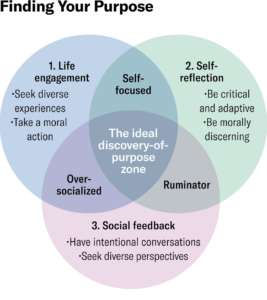
3. Talk About Your Goals and Seek Honest Feedback
One of the most underrated tools for finding your purpose is honest conversation. Sharing your aspirations with friends, siblings, mentors, or elders gives you fresh perspectives and helps you see your own goals more clearly. When someone you trust reflects your strengths back to you, it can feel like a light switching on.
Many young people have described how conversations about life goals with close friends left them feeling energised, less anxious about the future, and more motivated to pursue what truly matters. There is something deeply grounding about knowing that others are on a similar journey of figuring things out.
To start these conversations, try approaches like:
- “I have been thinking a lot about what I want from life and would love to talk it through with you. Would you be open to sharing your thoughts too?”
- “I need a sounding board as I think about my future — would you be willing to play that role? I am happy to do the same for you.”
- “What are your plans for the future? What kind of life do you want to build? What excites you the most when you think ahead?”
Beyond sharing, actively seek feedback. The people who know you well — a teacher, a parent, a college senior, a close friend — often see your strengths more clearly than you do. Ask them:
- “You have known me for a while. What do you think are my greatest strengths? What am I genuinely good at?”
- “How do you feel I contribute to your life? Is there something I do that others around you do not?”
- “When do you see me at my best? When do I seem most alive and energised?”
This kind of feedback is not flattery — it is valuable information that can redirect your energy toward where you can have the greatest impact.
Balancing Your Approach
You may already be doing some of these things naturally. Perhaps you love trying new experiences but rarely sit with them long enough to reflect. Or maybe you are deeply introspective but tend to stay in your own world without talking to others. Or perhaps you talk about your goals all the time but have not backed it up with enough real-world experience.
The real key is to keep all three in balance — experience, reflection, and conversation — and to consciously strengthen whichever one you tend to neglect.
If you are always thinking and talking but not doing: prioritise getting into real-world experiences, however small.
If you are always doing and talking but not pausing to reflect: start a simple journal — even five minutes a day can bring surprising clarity.
If you are deeply engaged and reflective but rarely talk to others: begin one honest conversation this week. Seek out someone whose perspective you respect and open up.
A Final Word
As you engage sincerely with these three practices, your purpose will slowly begin to crystallise — not all at once, but gradually, like clarity emerging from fog. It may become something you can articulate clearly — a personal mission you carry into your work and relationships. Or it may simply be a quiet inner compass that guides how you show up in the world each day.
Either way, living with purpose is a lifelong pursuit. It does not mean your path will be smooth or that confusion will disappear overnight. But these practices will help you build the foundation — and over time, a deeper, more purposeful life will begin to take shape.