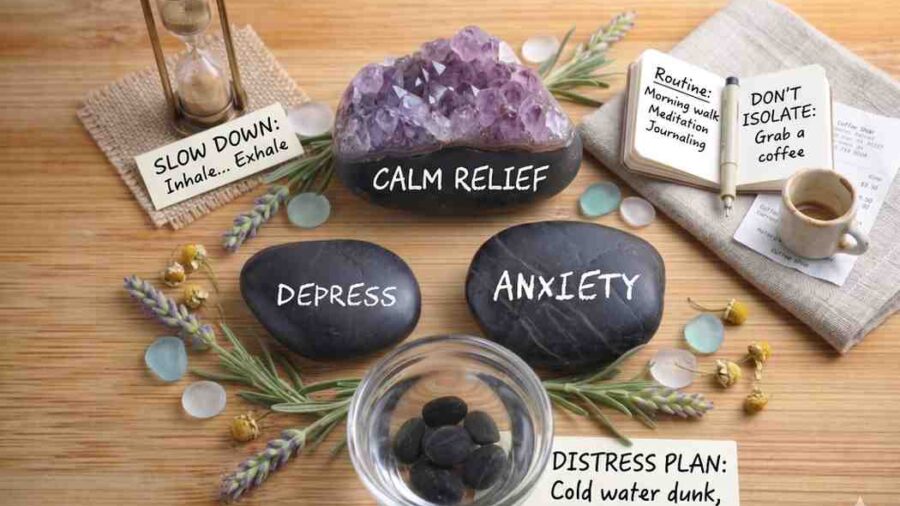
Anxiety doesn’t always announce itself dramatically. Sometimes it’s a flutter in the chest, a dull pressure behind the eyes, or that low, persistent hum underneath your thoughts — the mental equivalent of a mosquito you can’t quite catch. For many people, it’s simply part of daily life.
The triggers are hardly mysterious. Violent global conflicts, economic uncertainty, widening inequality, and the rapid rise of AI have given us no shortage of things to worry about. And while anxiety may be understandable given the state of the world, it makes leadership, focus, and productivity considerably harder — especially when your jaw is clenched and your mind is somewhere far from your desk.
Not everyone has the luxury of stepping away. So here are a few strategies that can help you get through the workday when anxiety feels particularly acute.
Slow Down Before You Spiral
When anxiety rises, the instinct is often to push harder — to outpace the feeling by staying busy. This rarely works. What does work is pausing long enough to notice what’s happening in your body before things escalate.
A useful practice is the body scan: a brief, deliberate check-in where you notice physical tension — a clenched jaw, tight shoulders, shallow breathing — before it becomes a full-blown spiral. Pairing this with scheduled daily check-ins (“How do I feel right now, and why?”) can help you build an early-warning system for your own anxiety patterns.
Once you’ve identified what you’re feeling, break your workload into small, manageable tasks. You don’t need to do your best work on your hardest days. Doing something — anything — is often enough.
Don’t Withdraw
Isolation feels appealing when anxiety peaks. But staying in your own head tends to make things worse, particularly if the people around you are equally wound up. What helps is seeking out people who offer perspective rather than co-rumination — those who listen actively and help you move toward solutions rather than deeper spiraling.
This doesn’t always require a serious conversation. Sometimes simply being out in the world — at a coffee shop, on a walk, in a grocery store — is enough to interrupt the loop.
Build a Supportive Routine
Routine is underrated as an anxiety management tool. The key is choosing habits that support your wellbeing — not punishing yourself into productivity, but committing to practices you know, intellectually, will help: daily movement, time outdoors, journaling, meditation.
There is no single correct answer here. Cooking, gardening, creative hobbies, exercise, and music are all evidence-based approaches to reducing anxiety and regulating emotion. The goal is to find what works for you, and then do it consistently — especially on the days you least want to.
Have a Plan for When It Gets Bad
Sometimes anxiety crosses into distress — intense enough to overwhelm your usual coping strategies and begin interfering with daily life. When that happens, the tools that worked before may not be enough.
It helps to prepare in advance. Some find relief in breathwork or grounding techniques. Others rely on prescribed medication. One technique worth knowing: submerging your face in cold water triggers what’s known as the diving reflex, an evolutionary response that activates the parasympathetic nervous system and helps calm the body quickly. Whatever your toolkit, write it down while you’re calm — so it’s accessible when you’re not.
None of this replaces professional support. If your anxiety is significantly affecting your quality of life, speaking with a medical professional is the right first step.
But anxiety is worth talking about — because there are real things to be anxious about, and because feeling it is, in some ways, a sign that you’re paying attention. The discomfort is real. So is your capacity to move through it.
Sources and Citations : Harvard Business Review, Morra Aarons-Mele, Gretchen Gavett, Dr. Ellen Hendriksen, Charlotte Lieberman, Ethan Kross.