Preface: Why India Should Pay Attention
For Indians, the story of Cuba is not a distant geopolitical abstraction. It is, in many ways, a mirror of values India has long held dear — the right to self-determination, resistance to colonial and imperial pressure, and the pursuit of development on one’s own terms. India was, in fact, among the first nations in the world to recognise the Cuban revolutionary government in 1959. Just months after the revolution, Commandante Che Guevara visited India and held three personal meetings with Prime Minister Jawaharlal Nehru — a moment that cemented a friendship rooted in shared anti-colonial solidarity and the emerging spirit of the Non-Aligned Movement (NAM).
Sixty-six years later, that relationship remains alive and relevant. In 2025, Prime Minister Narendra Modi and Cuban President Miguel Díaz-Canel met on the sidelines of the BRICS Summit in Brazil, spending more than thirty minutes discussing how to deepen trade, commercial, and financial ties. India’s Minister of State for External Affairs, Pabitra Margherita, visited Havana in November 2025. Indian companies are exploring partnerships with Cuba in pharmaceuticals, biotechnology, renewable energy, and education. Bilateral trade, while modest, exceeds USD 100 million annually — with India exporting pharmaceuticals, medical equipment, organic chemicals, and engineering goods, while importing Cuban pharmaceutical innovations and tobacco products.
And yet, as these ties deepen, Cuba is burning — not from war, but from decades of economic strangulation that has, in 2025–2026, converged into one of the worst humanitarian crises the island nation has ever seen. Understanding this crisis is not merely an academic exercise. For a country like India — which has faced its own share of external pressure, technology denial regimes, and sanctions threats — the Cuban story is a cautionary tale about what unchecked unilateral coercion can do to a sovereign people.
Part 1: The Ground Reality — What Cubans Are Living Through Today
A Nation Without Light
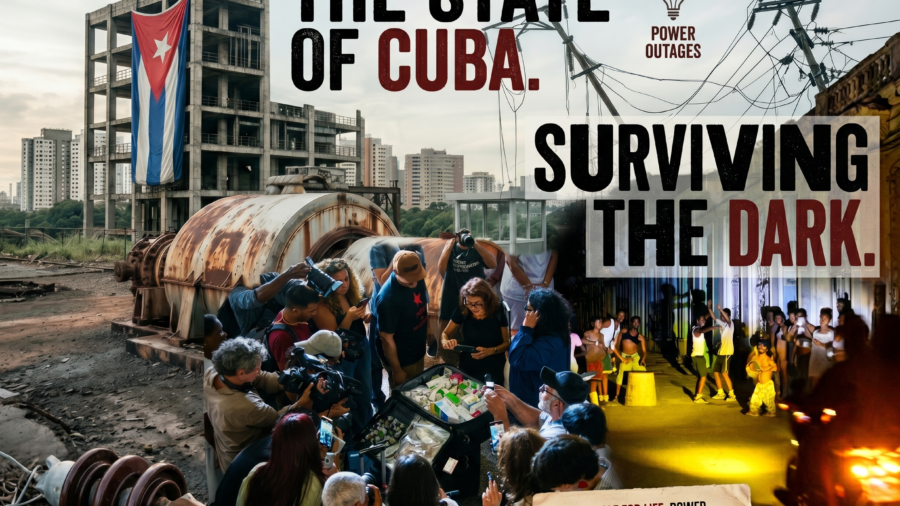
The most immediate and visible face of Cuba’s crisis in 2025–2026 is darkness — quite literally. Across the island, Cubans are enduring 18 to 22 hours of daily blackouts. Homes go without electricity for the better part of the day. Refrigeration fails. Cooking becomes impossible. Water pumps stop running. In a tropical country where temperatures regularly climb above 30°C, the absence of even a fan can be dangerous, especially for the elderly, children, and the chronically ill.
This is not a temporary inconvenience. In February 2026, Cuba took the extraordinary and humiliating step of suspending fuel supply for refuelling commercial aircraft at José Martí International Airport — an act that signals not mere scarcity, but a near-total collapse of the nation’s fuel reserves. The energy grid, already aged and underfunded, simply cannot function without a steady supply of imported fuel, and that supply has been choked off.
For an Indian reader, imagine the impact of a sustained power cut affecting not just one state but an entire country — and imagine that there is no national grid from a neighbouring region to fall back on, no alternative fuel market to tap, and no international bank willing to extend a line of credit because of extraterritorial threats from a superpower. That is Cuba’s reality.
The Empty Plate
Cuba’s food crisis has deepened in tandem with the energy collapse. The country has long depended on food imports — a structural vulnerability that its domestic agriculture has not been able to fully offset. The fuel shortage has now broken down the agricultural supply chain from within: tractors lie idle, irrigation systems shut down, transport trucks cannot move produce from farms to cities.
The result is severe scarcity of basic staples — rice, cooking oil, milk, and bread. Long queues outside state-run stores have become a daily ritual. Informal black markets have expanded dramatically, where goods are sold at prices that most Cubans, earning state salaries worth a few dollars a month in real purchasing power, simply cannot afford. The expanding use of remittances from the Cuban diaspora — primarily in the United States, Spain, and Latin America — has become a lifeline, but one that deepens inequality between families who have relatives abroad and those who do not.
Infant mortality, once one of Cuba’s proudest achievements — kept below 5 per 1,000 live births, a figure that rivalled developed nations — rose to 8.5 per 1,000 in the first half of 2025, according to Cuba’s own foreign minister addressing the United Nations General Assembly. This single statistic, more than any geopolitical argument, captures the human cost of the crisis.
Healthcare: The Crown Jewel Crumbling
Cuba’s healthcare system has long been a source of national pride and international admiration. Cuba trained doctors for dozens of developing nations, including India’s neighbours. It sent medical brigades to disaster zones from Pakistan to Haiti. It produced vaccines and biotechnology innovations that competed on the world stage — including the widely-used Heberprot-P, a groundbreaking treatment for diabetic foot ulcers that India’s pharmaceutical sector has shown keen interest in.
But today, this system is under severe stress. Hospitals face power outages during surgeries. Medicines — many of which rely on Active Pharmaceutical Ingredients (APIs) that must be imported — are running short. India took a notable step in January 2025, donating APIs to Cuba sufficient to produce antibiotics for six months to a year, a gesture that was deeply appreciated in Havana. India also provided humanitarian assistance worth USD 1 million in the wake of devastating hurricanes Oscar and Rafael in late 2024.
Yet bilateral goodwill cannot substitute for systematic structural relief. Doctors are emigrating in unprecedented numbers. Disease risks are rising due to compromised sanitation, malnutrition, and disrupted vaccine cold chains. A healthcare system that was once proof that a poor country could achieve first-world health outcomes is now struggling to guarantee basic care.
Part 2: Understanding the Roots — Why Is This Happening?
No crisis of this magnitude has a single cause. Cuba’s 2025–2026 breakdown is the result of multiple reinforcing failures — some external, some internal, all interconnected. An honest analysis demands that we look at all of them.
The Embargo: The Original and Enduring Wound
The United States has maintained a comprehensive economic, commercial, and financial embargo against Cuba since 1960 — making it the longest-running trade embargo in modern history. Originally justified as a Cold War response to the nationalisation of American assets and Cuba’s alignment with the Soviet Union, the embargo has long outlived the geopolitical rationale that spawned it.
The embargo is not a passive restriction. It is an active, extraterritorial regime that penalises third-country entities — companies, banks, and shipping firms from Europe, Asia, and Latin America — for doing business with Cuba. This is the core of what makes the U.S. approach uniquely coercive: an Indian pharmaceutical company, for instance, risks being cut off from the American market if it conducts financial transactions with a Cuban state entity. This is precisely why India’s API donation was routed as humanitarian assistance rather than commercial trade.
The Trump administration’s return to a “maximum pressure” strategy in January 2025 escalated sanctions dramatically, specifically targeting fuel shipments and financial flows to Cuba. The impact was near-immediate: Venezuela, Cuba’s principal oil supplier, was already in crisis. Russia, another potential partner, was mired in its own geopolitical constraints. With secondary sanctions threatening any shipping company or fuel supplier willing to service Cuban ports, the island’s fuel reserves plummeted.
Between March 2024 and February 2025, Cuba’s foreign minister told the UN General Assembly, the blockade caused USD 7.5 billion in damages. The international community — overwhelmingly — has condemned this. In October 2025, the UN General Assembly adopted its 33rd consecutive annual resolution calling for an end to the U.S. embargo. 187 nations voted in favour in 2024; in 2025, the number shifted somewhat amid U.S. pressure, but the resolution still passed by an overwhelming majority. India has consistently supported this resolution — a position rooted in India’s principled opposition to unilateral coercive measures that violate the UN Charter.
For India, this is not merely a diplomatic stance. India itself has faced technology denial regimes — restrictions on dual-use technology, nuclear-related sanctions after 1998, and continuing pressure over trade with countries like Iran and Russia. India understands, from direct experience, how extraterritorial economic pressure distorts the sovereign decision-making of nations and harms civilian populations.
The Loss of Strategic Allies
Historically, Cuba survived external pressure through strong bilateral support — first from the Soviet Union during the Cold War, and then from Venezuela under Hugo Chávez, who supplied Cuba with subsidised oil in exchange for Cuban doctors and technical expertise. Both of these lifelines have now frayed beyond recovery.
The Soviet Union collapsed in 1991, triggering what Cubans call the “Special Period” — a decade of extreme scarcity. Venezuela’s Bolivarian project, increasingly mired in its own economic implosion, can no longer provide reliable oil exports. Russia, facing sanctions and military commitments in Ukraine, has neither the logistical reach nor the political bandwidth to meaningfully substitute. China, though an important trade partner, maintains a cautious, commercially-driven relationship with Cuba rather than the subsidised solidarity of the Soviet era.
Cuba thus finds itself in what strategists call a “structural dependency trap”: its economy was designed around guaranteed external support that no longer exists, and transforming that economy requires investment and breathing room that the embargo denies.
Internal Structural Weaknesses: The Other Side of the Ledger
An honest Indian perspective requires candour about Cuba’s internal failings as well. India’s own experience with centralised planning — from Nehruvian socialism to the reforms of 1991 — offers hard-won lessons about the limits of state-driven economic models.
Cuba’s centralised economic system has delivered remarkable achievements in health and education, but it has also produced chronic inefficiencies. Price controls have suppressed agricultural output. Limited private sector participation has constrained innovation and productivity. The slow pace of reform — even as small private enterprises were legalised in recent years — has meant that the economic system lacks the flexibility to adapt to shocks.
The currency crisis compounds everything. Cuba operated a dual currency system for decades, creating distortions that made economic planning nearly impossible. Even after the unification attempt in 2021, the Cuban peso has experienced severe devaluation and inflation in the informal economy — wiping out the savings and purchasing power of ordinary citizens. India’s own experience of currency management and inflation, particularly during the post-COVID period, gives Indian readers a frame of reference for how monetary instability cascades into everyday suffering.
Crumbling Infrastructure: The Physical Foundation of Collapse
Cuba’s infrastructure — its power grid, transportation network, water systems, and port facilities — has been chronically underinvested for decades. The energy grid runs on old Soviet-era machinery. Power plants that should have been decommissioned are still limping along. The distribution network loses an enormous share of electricity to transmission losses.
When the fuel supply dropped, this aged system had no resilience. Unlike a modern grid that can compensate through efficiencies or alternative sources, Cuba’s grid simply failed. The blackouts that followed were not a managed load-shedding exercise — they were uncontrolled collapses, leaving hospitals, water pumps, and food storage without power for unpredictable periods.
India, which has grappled with its own massive power sector reforms over the past decade — building 175 GW of renewable energy capacity, undertaking rural electrification through the Saubhagya scheme, and investing in smart grid technology — understands that grid resilience is not achieved overnight. But it also knows that underinvestment in infrastructure creates compounding vulnerabilities. Cuba’s grid failure is not merely a technical problem; it is the physical manifestation of decades of deferred modernisation.
Climate Vulnerability: The Invisible Accelerator
Cuba’s 2024–2025 experience with hurricanes Oscar and Rafael — which triggered India’s humanitarian assistance — illustrates a dimension of the crisis that often goes underreported: climate vulnerability. Cuba sits at the crossroads of Atlantic hurricane systems. Each major storm sets back infrastructure, agriculture, and economic activity by years. With already-depleted resources and no access to international insurance or credit markets — the embargo extends even to financial instruments — Cuba cannot recover between disasters the way a comparable nation might.
For India, which itself bears the brunt of increasingly erratic monsoons, coastal flooding, and cyclones intensified by climate change, Cuba’s exposure resonates deeply. Both countries are signatories to the Paris Agreement and advocates for climate justice — the principle that nations that contributed least to climate change should not bear its heaviest burden. Cuba’s crisis is, in part, a climate justice story.
The Demographic Drain: Young Cuba is Leaving
Perhaps the most painful long-term consequence of the crisis is the mass emigration of Cuba’s youth. Hundreds of thousands of Cubans — many of them educated professionals, doctors, engineers, and teachers — have left the island in the past three years, primarily to the United States, Spain, and Latin America. In 2023 alone, more Cubans were encountered at the U.S.-Mexico border than at any point in recorded history.
This demographic haemorrhage has a compounding effect: it depletes the labour force, reduces tax revenues, increases the dependency ratio (more elderly citizens relative to working-age adults), and strips the country of the innovative capacity it needs to reform. India, which has itself experienced brain drain and understands the complex relationship between diaspora and development, recognises this dynamic acutely. The Cuban diaspora in the United States sends remittances home — but those remittances also create inequalities between families with overseas connections and those without, subtly corroding the social fabric of a society built on egalitarian ideals.
Part 3: The Perfect Storm — How the Crisis Escalated in 2025–2026
These causes did not operate in isolation. They formed a cascade:
Maximum pressure sanctions restricted fuel access → Fuel shortages crippled the electricity grid → Blackouts disrupted hospitals, food storage, water systems, and transport → Weak, ageing infrastructure amplified the damage beyond what any single shock could justify → Economic rigidity slowed the government’s ability to adapt → Social unrest and emigration accelerated, removing skilled labour from recovery efforts → Climate shocks (hurricanes Rafael and Oscar) added another layer of destruction before any recovery was possible.
Each factor magnified the others. The result was not merely an economic recession — it was a humanitarian emergency touching every dimension of Cuban life simultaneously.
Part 4: The Way Forward
There is no simple solution to Cuba’s crisis. But a framework for resolution would include:
On the external front, the lifting or substantial easing of U.S. sanctions, particularly those targeting fuel, medicine, and food supply chains, is the most immediate lever available. Humanitarian exceptions already exist in U.S. law; they need to be applied more broadly and the secondary sanctions that deter third-country actors need to be suspended.
On the regional front, Latin American nations — including Mexico, Brazil, and Argentina — can play a bridging role. BRICS membership, which Cuba has sought, could provide access to alternative financial infrastructure and trade mechanisms outside the dollar system.
On the internal front, Cuba itself must accelerate economic reforms — expanding the private sector, incentivising agricultural production, rationalising pricing, and creating conditions for the diaspora to invest productively rather than merely send remittances. These are difficult reforms for a government ideologically committed to a particular model, but they are unavoidable.
On the India-Cuba front, the relationship should move from warm symbolism to concrete action — expanded pharmaceutical and biotech trade, joint ventures in renewable energy, educational exchange programmes, and sustained diplomatic advocacy at multilateral forums.
Conclusion: The Burden Falls on Ordinary People
The 2025–2026 crisis in Cuba is, at its heart, a crisis of ordinary human beings — parents unable to feed their children, doctors operating without medicines, students studying by candlelight, the elderly sweltering through power cuts that last the better part of each day.
It is the product of decades of accumulated decisions — some made in Washington, some in Moscow and Caracas, and some in Havana itself. The blockade tightened the noose; internal rigidities limited Cuba’s ability to slip free of it; the loss of allies removed the safety nets; and a crumbling infrastructure turned each new shock into a cascade.
From an Indian perspective, the lesson is not a simple one. It is not sufficient to say “the blockade is wrong” without also acknowledging that resilient, diversified economies are better equipped to survive external pressure. Nor is it sufficient to say “Cuba must reform” without acknowledging that reform is infinitely harder when you are strangled from outside.
What India can offer Cuba — and what it can advocate for on Cuba’s behalf — is a vision of development that honours sovereignty, values human dignity, and insists that the international community’s rules apply equally to the powerful and the powerless alike.
That, after all, is the spirit in which Che Guevara met Jawaharlal Nehru in 1959 — and it remains as relevant today as it was then.
This article draws on data from the United Nations General Assembly, the Indian Ministry of External Affairs, the Embassy of India in Havana, the Indian Economic Trade Organization (IETO), and publicly available reporting from international media and research institutions. All figures cited are sourced from official or UN-verified statements.