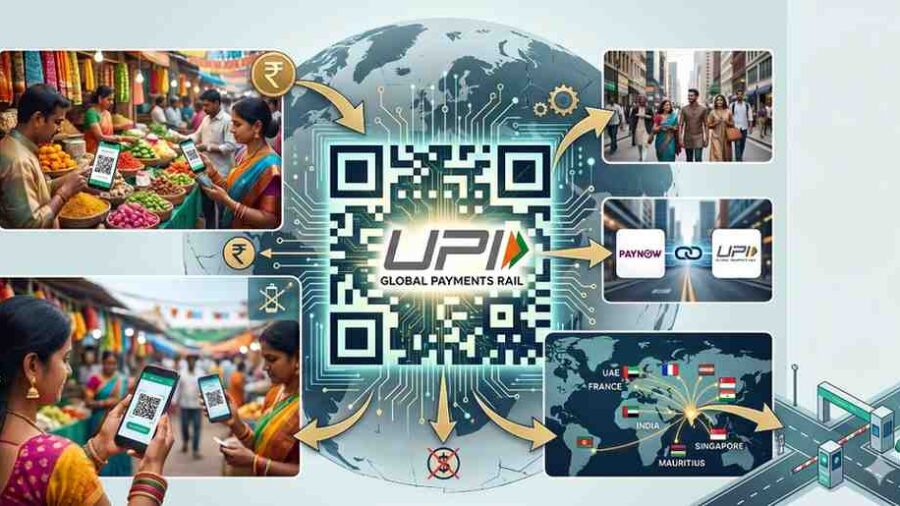
From Bazaars to Borders
A decade ago, India was still largely a cash economy. Today, it runs on a payments rail that has become arguably the most consequential piece of financial infrastructure any emerging market has built in the 21st century. The Unified Payments Interface processed over 250 billion transactions in 2025 alone, valued at approximately $3.4 trillion — representing nearly 50% of global real-time digital transactions, making it the world’s largest real-time payment system, outpacing China’s Alipay, PayPal, and Brazil’s Pix.
The natural next question — one that Indian policymakers, fintech investors, and geopolitical analysts have been pressing — is whether that domestic dominance can be projected outward. The answer, as of mid-2026, is: partially, and unevenly.
The Footprint So Far
UPI’s global roll-out is managed by NPCI International Payments Limited (NIPL), a wholly owned subsidiary of the National Payments Corporation of India. The strategy has been to prioritise corridors where Indian diaspora density and tourist flows create natural demand. By 2026, UPI has expanded to 12+ countries, with Cyprus and Qatar having been added in 2025, covering the EU and Gulf region.
The current live markets include Bhutan, Nepal, Sri Lanka, Mauritius, Singapore, France, UAE, Qatar, Cyprus, and Bahrain — a mix of South Asian neighbours, Gulf states with large Indian worker populations, and selective Western outposts. Cross-border UPI transactions grew more than 20 times to over 755,000 in FY25 from just 37,060 payments in FY24, and in the first four months of FY26 alone, it clocked 601,000 transactions — an annualised pace that would represent another quantum leap.
UPI’s expansion in the UAE has been particularly strategic, supporting that country’s vision of becoming a cashless economy while enhancing cross-border payment experiences for the millions of Indians who travel between the two nations annually.
The Singapore corridor remains the most architecturally significant. The UPI-PayNow bilateral link — connecting India’s and Singapore’s real-time payment rails directly — is widely cited as the model for what serious interoperability looks like, as opposed to simple merchant-acceptance arrangements. India is also pursuing plans to link UPI with Europe’s instant payments system, with strategic negotiations ongoing with several East Asian and Gulf nations.
On the multilateral front, India is participating in BIS’s Project Nexus — an initiative to link national fast-payment systems across multiple countries into a single cross-border network — which could eventually give UPI access to an interconnected grid rather than requiring bilateral deals one country at a time.
What the Numbers Conceal
The headline transaction numbers are impressive but require contextualisation. The overwhelming majority of cross-border UPI usage today is driven by Indian tourists and Indian diaspora — people spending their own rupees abroad, not foreign nationals adopting UPI as a preferred payment method. NRIs using UPI abroad remain limited by the requirement for Indian bank accounts and mobile numbers. This structural constraint means UPI’s international presence is, in most markets, a convenience layer for the Indian traveller — not a genuinely embedded local payment option.
UPI currently faces competition from established giants like Visa and Mastercard, which command vast merchant networks and proven interoperability. More importantly, merchant acceptance infrastructure in most live markets remains thin. Merchants outside Indian-dense tourist zones have little incentive to install UPI QR infrastructure when they already have Visa/Mastercard coverage. This is a classic network effect problem: UPI needs merchant density to attract users, and merchant density requires user scale — a chicken-and-egg dynamic that India’s domestic rollout solved through regulatory mandate, which is unavailable abroad.
Where the Friction Is
The structural barriers to deeper UPI internationalisation are well-understood within policy circles but under appreciated in popular coverage.
Regulatory fragmentation is the primary constraint. UPI’s real-time payment speed is outpacing compliance frameworks across foreign exchange rules, AML/KYC obligations, data localisation, and supervisory oversight. Each new country requires a bespoke negotiation with local regulators, central banks, and often commercial banking lobbies that have a material interest in protecting existing cross-border payment revenue streams.
Data localisation creates a bilateral tension that is particularly acute. The RBI’s data localisation requirements mandate that all data related to the payment system must reside exclusively in India, while many partner governments have their own data residency requirements that may conflict with Indian regulations. This is not a theoretical problem — it has actively complicated onboarding in markets with strict data sovereignty frameworks.
The zero-MDR model is a domestic political commitment that becomes economically unsustainable at scale internationally. While UPI transactions are largely free domestically, sustaining such a model internationally demands alternative revenue strategies that NPCI International has not yet publicly articulated. This matters because merchant acquirers in foreign markets need a commercial incentive to accept UPI — and zero-cost is not a proposition that travels well through third-party banking intermediaries.
Geopolitical positioning is the subtler friction. UPI’s internationalisation is, implicitly, a soft-power and strategic autonomy play — reducing dependence on dollar-denominated payment rails and Western card networks. Each new corridor will test UPI against different regulatory cultures, use cases, and technology standards, and success in advanced markets would matter because it would show Indian digital infrastructure can meet tighter compliance and security benchmarks. But that same framing can make partner-country regulators cautious: accepting UPI infrastructure means accepting NPCI’s (and, by extension, India’s) architecture as the backbone of a critical national system.
The Road to 2028
The RBI is working on expanding UPI to 20 countries by 2028–29, with 400+ million users now on the platform. The RBI’s Payments Vision 2028 document, released in March 2026, introduced a strategic roadmap emphasising cross-border fund transfers through regulatory liberalisation and technological initiatives, including single-window applications for obtaining authorised permissions.
The most credible path to meaningful internationalisation runs through three tracks simultaneously. First, deepening bilateral interoperability deals on the Singapore-PayNow model, particularly with Gulf states where Indian worker remittance volumes are high enough to justify the regulatory investment. Second, participating constructively in multilateral frameworks like Project Nexus, which could compress the transaction cost of building corridor by corridor. Third, and most importantly, resolving the domestic tension between data localisation mandates and cross-border operational requirements — a contradiction that cannot be papered over indefinitely as the network scales.
The Bottom Line
UPI’s internationalisation is real, but it is still largely a story about Indians paying abroad — not a story about the world adopting an Indian standard. The architecture is genuinely world-class. India is consistently the world’s largest recipient of inbound remittances, at over $134.5 billion in 2025, which gives UPI a natural demand base unlike most payment systems attempting cross-border expansion. But converting corridor access into embedded global infrastructure will require regulatory alignment, commercial model innovation, and geopolitical navigation that are considerably harder than the engineering problem India has already solved.
Whether UPI becomes the world’s payment rail or remains India’s export-grade tourist product will depend less on technology and more on diplomacy. That, more than any transaction milestone, is the real story of UPI’s next chapter.
- Sources and References: WhalesBook, Cyril Amarchand Blogs, CoinLaw, Policy Circle, Global Scientific Journal, Finance Mostly, Newsonair, Business Standard