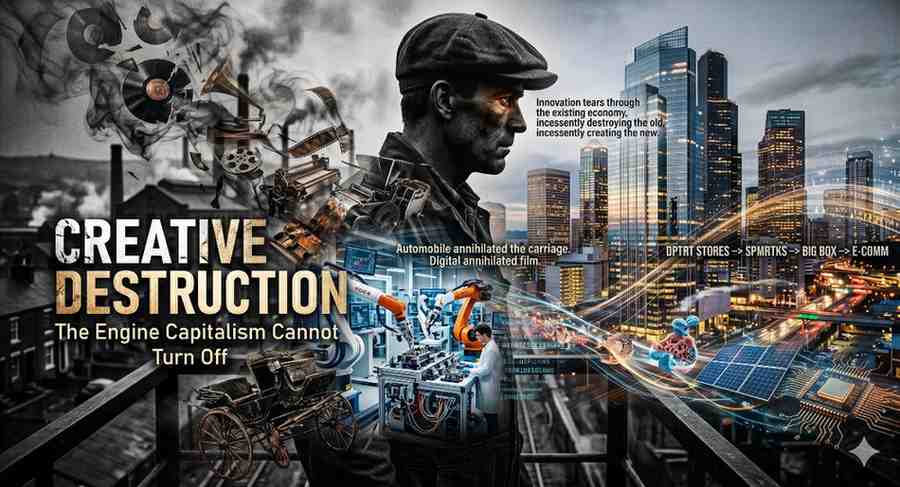
There is a paradox at the heart of market economies: the very forces that build industries also destroy them. Joseph Schumpeter gave this paradox a name in 1942 — creative destruction — and in doing so, offered perhaps the most honest description of how capitalism actually works.
The idea is deceptively simple. Innovation does not merely add to an existing economy; it tears through it. The automobile did not just supplement the horse-drawn carriage industry — it annihilated it, along with every ancillary trade built around it: farriers, livery stables, carriage makers, oat suppliers. In their place rose something vastly larger: oil refineries, steel plants, rubber factories, road construction firms, motels, drive-throughs, suburbs. The destruction was real and painful for those caught inside it. The creation was enormous and diffuse, spreading across industries and generations that never knew what had been lost.
Schumpeter’s Radical Insight
Classical economists had largely treated the market as a system tending toward equilibrium — prices adjusting, supply meeting demand, the economy finding its natural resting point. Schumpeter found this picture almost comically static. Real capitalism, he argued, is never at rest. It is a “process of industrial mutation that incessantly revolutionizes the economic structure from within, incessantly destroying the old one, incessantly creating a new one.”
The key word is incessantly. This is not a periodic disruption, a bump in an otherwise smooth road. It is the road itself.
The entrepreneur, in Schumpeter’s framework, is the agent of this disruption — not the cautious manager optimizing an existing operation, but the visionary who introduces a new product, a new production method, a new market, or a new organizational form. The profit motive does not simply reward efficiency within a fixed game; it rewards those who change the game entirely.
The Mechanism in Practice
Creative destruction operates through a recognizable sequence. An innovator — a firm, an inventor, sometimes an entire industry — introduces something that performs an old function better, cheaper, or in a way previously unimagined. Incumbents face a choice: adapt or die. Many cannot adapt fast enough. Capital, labor, and talent flow toward the new paradigm. The old structures atrophy.
The 20th century is littered with examples. Department stores disrupted local merchants. Supermarkets disrupted department stores. Big-box retailers disrupted supermarkets. E-commerce disrupted big-box retail. Each wave destroyed livelihoods and business models that had seemed permanent. Each wave also created employment, wealth, and consumer surplus on a scale that dwarfed what it displaced — eventually, unevenly, and with little comfort for those caught in the transition.
Digital technology compressed this cycle to near-instantaneous. Kodak employed 145,000 people at its peak and dominated global photography for a century. Instagram, which destroyed much of its market, was acquired for $1 billion with 13 employees. The creative destruction calculus had never looked so stark or so brutal.
The Human Cost Problem
Here lies the central tension that economics has never fully resolved. Creative destruction is net-positive in aggregate — living standards rise, productivity improves, the economy expands. But the gains and losses do not fall on the same people. The factory worker in a declining industry does not automatically migrate into the growing one. The skills, the geography, the social networks built around an old industrial structure do not transfer cleanly.
Schumpeter was candid about this. He was not celebrating destruction — he was describing it. The political economy of creative destruction is, in fact, deeply unstable. Those who bear the costs are concentrated and visible; those who receive the benefits are diffuse and often oblivious to the source of their prosperity. This asymmetry creates powerful political pressures to slow or arrest the process — through tariffs, licensing restrictions, subsidies to incumbents, and regulatory barriers that protect established players from new entrants.
The irony is that these protective measures, however understandable, tend to delay the pain without eliminating it, while suppressing the creation that makes the destruction worthwhile.
The Innovation That Resists Disruption
Not all industries are equally susceptible. Sectors with high regulatory barriers (pharmaceuticals, aviation, banking), strong network effects (operating systems, social platforms), or enormous capital requirements (semiconductors, aerospace) exhibit what might be called slow-motion creative destruction — the churn is real, but measured in decades rather than years. Incumbent advantage is substantial enough to blunt new entry, creating oligopolies that persist long after a more competitive market would have reorganized them.
This raises a sharper question: when incumbents use political influence to entrench themselves, are they resisting creative destruction, or are they simply playing the game Schumpeter described — using every available means to capture and hold market position? Schumpeter might have said the latter. The disruption is merely deferred, not prevented. History tends to confirm this view.
The Schumpeterian Wager
What creative destruction ultimately demands is a kind of civilizational faith — the belief that the economy of tomorrow will be richer, more capable, and more humane than the one being dismantled today, even when the evidence is not yet visible. This is not a comfortable faith. It requires tolerating genuine suffering in the present for diffuse benefits in the future, accepting that the map of winners and losers will be drawn by markets rather than by deliberate social choice.
Societies that have made this wager — imperfectly, selectively, with significant state intervention at the margins — have generally prospered. Societies that have refused it, choosing preservation over disruption, have tended to stagnate, their protected industries growing fat and inefficient, their innovators leaving for more hospitable environments.
The question for any generation is not whether creative destruction will happen — it will, with or without permission — but whether the institutions surrounding it are strong enough to distribute the gains broadly and cushion the losses humanely. That is not an economic question. It is a political one. And it remains, as Schumpeter might have recognized, permanently unresolved.
The engine runs. The only choice is what to build on either side of it.
I felt the views were perfectly communicated. However for the common interest i feel the author should simplify the contents if the intent is to increase the reach to a broader and simple audience which might instill a thought fire to dig deeper in them.