Two of Asia’s largest democracies share ancient civilisational roots, a booming trade corridor, and a convergent strategic vision for the Indo-Pacific. With Prime Minister Modi set to visit Jakarta in July, the relationship is entering its most consequential chapter.
Long before diplomats wrote treaties or trade bodies issued frameworks, India and Indonesia were already connected. Sanskrit shaped the Balinese script. The Ramayana became the defining narrative of Javanese dance. The very name “Indonesia” carries the Latin root for India within it. For more than two millennia, these two civilisations moved goods, ideas, and people across the same waters that today carry coal tankers and container ships.
That ancient current has never stopped. It has simply taken on new forms — and in 2026, it is gaining speed at a pace not seen in decades.
$24.8B — Bilateral trade, FY 2025–26
$28.2B — Bilateral trade, FY 2024–25
$50B — Joint trade target
75 years — Formal diplomatic relations
(Source: DGCIS / TIA Portal, Department of Commerce, Government of India)
A Diplomatic Moment
In January 2025, Indonesian President Prabowo Subianto arrived in New Delhi as the Chief Guest at India’s 76th Republic Day celebrations — the highest symbolic honour India extends to a foreign leader. The visit yielded multiple memoranda of understanding covering maritime security, digital infrastructure, health, and defence collaboration. It was the clearest public signal yet that both governments regard the bilateral relationship as a strategic priority.
The momentum has continued through 2026. In June, Indonesian Foreign Minister Sugiono and External Affairs Minister S. Jaishankar convened the 8th India-Indonesia Joint Commission Meeting in New Delhi, specifically to prepare the ground for Prime Minister Modi’s upcoming visit to Jakarta in July. That visit — the first by an Indian Prime Minister to Indonesia in nearly a decade — is expected to produce concrete deliverables in connectivity, pharmaceutical trade, defence, and digital cooperation. According to the Indian Ambassador in Jakarta, over 150,000 members of the Indian diaspora currently call Indonesia home.
“The partnership between Indonesia and India must result in more concrete and mutually beneficial cooperation.” — Indonesian Foreign Minister Sugiono, June 2026
The relationship has been formally defined as a Comprehensive Strategic Partnership since 2018, when Modi visited Jakarta and both nations signed a “Shared Vision of Maritime Cooperation in the Indo-Pacific.” That framework now governs a relationship spanning defence exercises, joint port development, central bank cooperation, and a growing trade architecture.
What the Trade Relationship Actually Looks Like
Bilateral trade surged eightfold from $4.3 billion in 2005–06, peaking at a record $38.84 billion in FY 2022–23. Since then, the corridor has moderated — full-year FY 2024–25 trade stood at $28.16 billion, and FY 2025–26 came in at $24.78 billion, reflecting softer global commodity prices and a contraction in Indian exports. Both nations have set a joint target of $50 billion, which remains to be achieved. The India-ASEAN Free Trade Agreement provides the structural foundation for this corridor, reducing tariffs and improving market access.
The trade is deeply imbalanced — and the gap is widening. In FY 2025–26, India exported $4.49 billion to Indonesia while importing $20.29 billion, leaving a trade deficit of $15.8 billion. Indonesia ranks 12th among India’s import sources but only 30th as an export destination. India’s exports to Indonesia contracted 16.52% year-on-year in FY 2025–26, following a 10.16% decline the previous year — a trend that underscores how much room exists to grow India’s export presence in this market.
India primarily imports energy and agricultural commodities from Indonesia. Mineral fuels and oils dominate at $6,605 million — the single largest category. Palm oil and vegetable fats follow at $3,947 million, iron and steel at $1,667 million, electrical machinery at $862 million, inorganic chemicals at $737 million, miscellaneous chemical products at $729 million, and cocoa at $680 million. These are structurally necessary purchases — feeding India’s power plants, cooking oil supply chains, steel industry, and manufacturing base.
On the export side, nuclear reactors, boilers, and machinery lead at $502 million, followed by vehicles and auto parts ($424 million), organic chemicals ($308 million), meat ($301 million), mineral fuels ($253 million), oil seeds ($196 million), electrical machinery ($156 million), ships and floating structures ($154 million), tobacco ($145 million), and inorganic chemicals ($143 million).
(All trade figures: DGCIS / TIA Portal, Department of Commerce, Government of India — FY 2025–26)
Sector by Sector
Energy: Mineral fuels and oils from Indonesia were India’s single largest import at $6,605 million in FY 2025–26, down from $8,542 million in FY 2024–25 and a peak of $14,776 million in FY 2022–23, as global coal prices have softened — though volumes remain structurally high. Indian companies including Tata Power hold significant positions in Indonesian coal. Both nations are now exploring joint renewable energy and green hydrogen collaboration as part of their 2030 energy transition commitments.
Agri & Oils: Indonesia is the world’s largest palm oil producer. India imported $3,947 million in animal and vegetable fats and oils from Indonesia in FY 2025–26 — the second largest import category after mineral fuels. Despite Indonesia introducing a 10% export levy on palm oil in May 2025, Indian imports have remained resilient, with shipments expected to exceed 5 million tonnes for the year. An MoU between the Indonesian Palm Oil Council (IPOC) and the Indian Vegetable Oil Producers’ Association (IVPA) now governs this food security corridor.
Pharmaceuticals: Indonesia has actively courted Indian pharma companies. An Indonesian delegation visited India in 2024 to meet pharma companies, and the Indonesian drug regulator BPOM met India’s CDSCO and FSSAI in April 2025 to deepen regulatory cooperation. India is one of the world’s top generic drug manufacturers; Indonesia’s 280 million population is significantly underserved in domestic pharmaceutical production.
Digital & Fintech: India’s digital public infrastructure — UPI, Aadhaar, ONDC — has attracted serious interest from Indonesian policymakers. Both countries signed an MoU on digital cooperation during President Prabowo’s state visit in January 2025. Indonesia’s Deputy Minister of Communication and Digital Affairs has held dedicated meetings with India’s Ministry of Electronics and IT on cooperation in digital affairs.
Defence: India and Indonesia conduct joint Army exercises (Garuda Shakti, 10th edition held December 2025) and Navy exercises (Samudra Shakti). The BrahMos supersonic cruise missile deal — estimated at $450 million — was confirmed to be in its “final stages” at the Shangri-La Dialogue in June 2026 by India’s Defence Secretary. Notably, ships, boats and floating structures already feature in India’s top export categories to Indonesia at $154 million in FY 2025–26, signalling a defence-industrial relationship already taking shape.
Critical Minerals: Indonesia holds the world’s largest nickel reserves at 55 million metric tons — approximately 42 percent of global reserves — and accounts for around 60 percent of global nickel mine production. As India scales its EV manufacturing ambitions, structured minerals partnerships with Indonesia in nickel, bauxite, copper, and tin would reduce dependence on Chinese-controlled supply chains.
Why the Strategic Logic Is Now Irresistible
Trade statistics tell one story. Geopolitics tells another — and the two have begun to reinforce each other in ways that make this relationship genuinely important to watch.
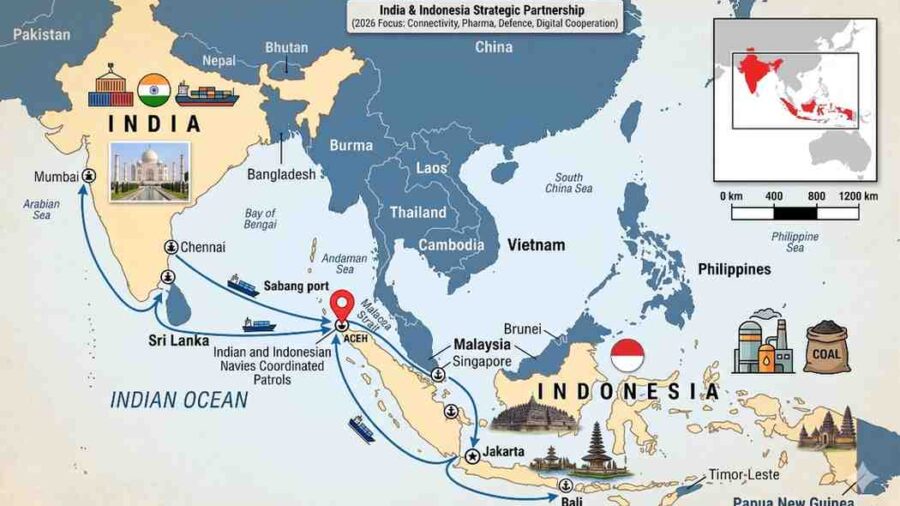
Both India and Indonesia sit in the Indo-Pacific and share an abiding interest in a rules-based maritime order. Indonesia controls three of the world’s most critical sea lanes — the Straits of Malacca, Sunda, and Lombok — through which an enormous share of global trade flows. India’s Andaman and Nicobar Islands share a maritime border with Indonesia’s Aceh province. The two navies already conduct coordinated patrols and are jointly developing Sabang Deep Sea Port.
Neither country is formally allied with any major power. Both practise strategic autonomy — India through its independent foreign policy tradition, Indonesia through its longstanding doctrine of “bebas aktif” (free and active). Indonesia joined BRICS in 2025, opening yet another multilateral channel through which the two countries can coordinate on trade and development finance. Both are also members of the G20, both are large democracies navigating internal development pressures, and both are managing their strategic relationships with China carefully and on their own terms.
Indonesia controls three of the world’s most critical sea lanes. India’s Andaman and Nicobar Islands share a maritime border with Aceh. The geography alone makes this relationship indispensable.
Where the Opportunities Are — and Who Can Seize Them
For Indian businesses, the Indonesia opportunity is not abstract. Pharmaceuticals represent the most immediately actionable avenue. Indonesia’s drug regulator BPOM has been engaged directly with India’s CDSCO, creating a regulatory pathway that did not previously exist at this level of seniority. Indian generic manufacturers who move early — building distribution partnerships, pursuing joint ventures, or establishing manufacturing presence — will have an advantage that is difficult to replicate.
The digital corridor is equally compelling. India has built sophisticated digital public infrastructure over the past decade, and Indonesia is actively seeking to learn from that model. For Indian technology firms in fintech, digital identity, and payments infrastructure, Indonesia is a market of 280 million people with rapidly rising smartphone penetration and an appetite for financial inclusion at scale.
Critical minerals deserve special attention from Indian investors and policymakers. As the global energy transition accelerates, access to nickel — central to EV battery technology — becomes a strategic imperative. Indonesia accounts for roughly 60 percent of the world’s nickel mine production and 42 percent of global reserves. Structured investment frameworks and offtake agreements negotiated now will matter enormously as India’s EV sector scales over the next decade.
For smaller players — traders, consultants, content professionals, and entrepreneurs — the opportunity lies in the gap between the two economies’ knowledge of each other. Indian businesses systematically underestimate Indonesia, often treating the ASEAN region as a monolith. Anyone who can credibly bridge that knowledge gap through research, advisory, facilitation, or media is positioned in a space with very little competition.
The Challenges Are Real
A balanced account requires acknowledging what holds this relationship back. The trade deficit is a persistent and growing structural irritant — India’s deficit with Indonesia widened to $15.8 billion in FY 2025–26, even as total trade contracted. India’s exports to Indonesia fell 16.52% in FY 2025–26 after a 10.16% decline the prior year, meaning Indian exporters are losing ground, not gaining it. Indonesia has at times used export restrictions on commodities — most notably the 2022 palm oil export ban — to protect domestic industries, disrupting Indian supply chains with little warning. Indonesia also implemented a full ban on raw nickel ore exports in 2020 to force downstream value addition within its borders, a policy that has reshaped global supply chains and which India must navigate carefully.
Regulatory complexity in Indonesia is also a genuine obstacle. The country’s decentralised governance structure means that doing business in Jakarta is a materially different experience from doing business in Surabaya or Medan. And the cultural distance — though smaller than it appears on the surface — is real. Indonesian business culture runs on relationship, trust, and patience in ways that can frustrate partners accustomed to India’s faster-paced negotiating style.
Looking Ahead
The trajectory of India-Indonesia relations over the next decade will be shaped by the choices made in the next few years. Prime Minister Modi’s visit to Jakarta in July 2026 is expected to accelerate formalisation of key cooperation frameworks in defence, digital, and supply chains. The ASEAN-India Trade in Goods Agreement review, long delayed, may finally find political momentum. Local currency settlement between the two central banks — initiated through the 2022 RBI–Bank Indonesia MoU — reduces transaction friction in ways that compound over time.
India and Indonesia have seventy-five years of diplomatic relations, a civilisational connection that predates both their modern states, and a strategic alignment that requires no outside framework to sustain. What they have lacked is the consistent, senior-level attention needed to translate potential into policy, and policy into commerce. That attention is now arriving. The question is whether businesses, analysts, and entrepreneurs on both sides are ready to meet it.
India and Indonesia have never needed external pressure to find common ground. They have simply needed the right moment. That moment appears to be now.
Sources & References
Department of Commerce, Government of India — DGCIS / Trade Intelligence and Analytics (TIA) Portal, India Briefing / India-Indonesia EFD, Consulate General of India, Bali, ANTARA News, Wikipedia, WION, USGS Mineral Commodity Summaries, February 2026, IEEFA / ORF